Tuesday, February 5, 2013

Idle No More movement in Hawaii called for indigenous right


        Choosing the 120 years anniversary of the overthrown of Hawaii’s monarchy, activists rallied in supporting the Idle No More indigenous movement on January 16 in Honolulu. People in Hawaii were brought together with the theme “We are the people” as well as the goal to improve human right and to protest against GMOs (genetically modified organism) food. They aimed to bring the voice of the grassroots to government. 

        Tevita Kaili, Associate Professor of BYU-Hawaii, was able to participate in the rally. “I attended with the identity of a native Oceanian. I am not native to Hawaii but to the region. I am a Tongan and as an indigenous person, it is my responsibility to fight for the indigenous right for the environment, food, and all other kinds of issue.” 

         Kaili explained the purpose of the native activists was to call for a respectful co-existing environment. “Indigenous people (Hawaiians) are asking for a way to be able to live peacefully together with the settlers (Westerners). They want to compromise the land, the language, and the environment. They feel like the settlers are destroying the land by urbanization.”
 
 “It is not a matter of race,” said Kaili. “The activists were calling for self determination. Native Hawaiians want to be independent, maybe in the sense of politics or maybe have a native government. They want to be de-colonized [from Americanization],” Kaili said. 
Kaili said the movement in Hawaii themed differently from the other Idle No More movement in North America or Euro. He said, “The local theme in Hawaii was specifically toward the nation of Hawaii. There is problem such as the GMF. Big companies want to change the gene of taro and taro means something special to the Hawaiian, so they are upset.” 

        He also expressed he experienced a very peaceful rally. “Most indigenous people believe peaceful demonstration is the way to get the message to the world…. Although some Hawaiians believe to forget about the past and move on, there should be some sort of justice after forgiveness.”

        “I think we are moving there. The coalition between the indigenous and non-indigenous is coming together,” said Kaili. “There is a lot of settlers support the indigenous activities. The Idle No Move movement is getting bigger and devise. It is powerful. Lots of people are working together to create coalition. I guess a lot of people realize what is good for the indigenous is also good for the others, for example, saving the water, environment, and human right.”

Ikaika Wright, a native Hawaiian and a Hawaiian Studies sophomore, described the necessity of this rally with a quote from Vandana Shiva (Indian philosopher and environment activist), “In the making of your own food, is the making of freedom”. 

“We, as the people of Hawaii, are in a very unstable time with our continued dependence on outside support for the basic necessities of life,” said Wright. “That compounded upon the breakdown of our communities through development, which is further crippling any hope of us to create a healthy, sustainable way of life.” 
Wright continued, “I think it is important people come together and take control of our resources, and not allow their use to be dictated by big business, which has continued to marginalize the needs of the people here for their own economic interest and muscle their way around government.”
 
        After attending the rally, Ben Schmidt, a senior communication from Calif., said he had a better understanding about Hawaiian culture and the current issues that they face. “I learned that GMOs aren't necessarily in favor of the local people. Locals rather produce their own food and live off the land like they have in the past.”
        Idle No More (INM) is a growing indigenous rights movement around the world. INM urges local government to “repeal all legislation which violates treaties, indigenous sovereignty and subsequently environmental protections of land and water”, according to the official website. 

On Jan. 17, 1893, the Hawaii’s monarchy and Queen Liliuokalani were overthrown by the American-backed Business men and western missionaries. The kingdom of Hawaii was led to the dissolving and later on became the 50th state of the United State, according to the New York Times.

A Day of Service and Learning – BYU-H Students Visit the Ancient Hawaiian Religious Site


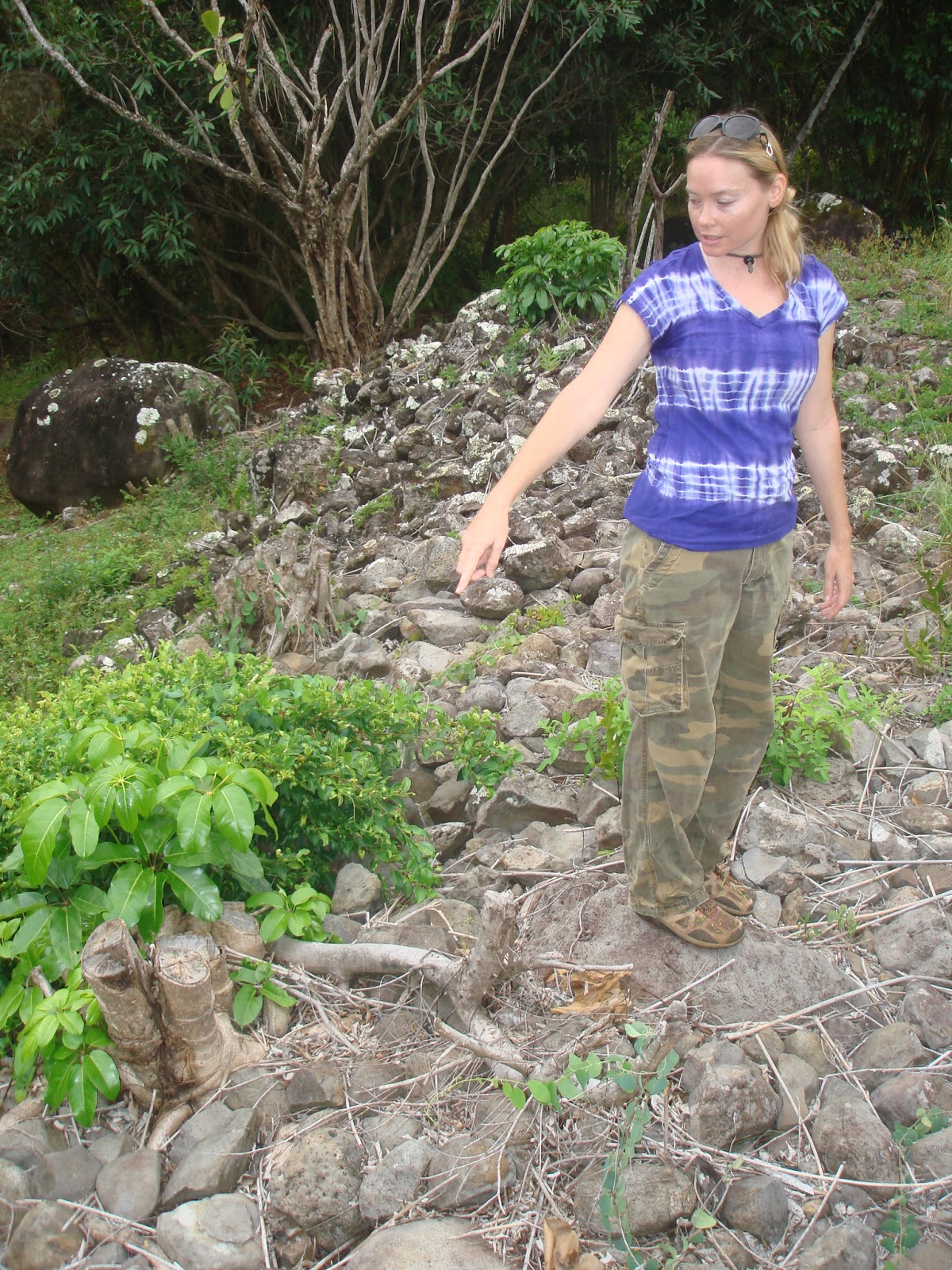
        Sponsored by international cultural studies department, over 30 students from class anthropology 105 and peace-building major were able to visit Hau’ula for an archaeological investigation and a community service to the Maunawila Heiau – an ancient Hawaiian religious site on October 13. 

         The visit was led by BYU-H professions Rebekah Walker, Special Instructor of ICS, and Tevita Ka’ili, Associate Profession in anthropology. Explained the purpose of the service was to “help the anthropology 105 students to learn more about the native Hawaiian sacred site”, said Ka’ili. “We are anthropologists….it is important we learn in the field,” he said. “We were not there to restore but to clear the site. So we can study the stone….. Students are very respectful and enjoy learning more about Hawaiian culture.” 

A Heiau is a place of worship which made out of stone structure. Ancient Hawaiian believed the Heiau can make the medicine powerful, so it was also a place of healing and to make medicine for the chief. Ancient Hawaiian visited the Heiau when life went wrong.

Today, this Maunawila Heiau is no longer in use. Some native Hawaiians in Hua’ula were interested in restoring their ancient culture, tradition, and religion; therefore, BYUH-H was contacted with the chance to serve and to visit the sacred Heiau, according to Ka’ili.

Professor Rosanna Runyon Thurman, Archeologist from University of Hawaii, and two more Archeologists were invited to direct the Heiau investigation. She offered a lecture to BYU-H students before the visit and guided students to clean the site. Thurman guessed the Maunawila Heiau was used to be a healing Heiau, but the structure was too old that she could not find any evidence to support her assumption.

Thurman did not find any Ki’i either around the Heiau. Ki’i is a wood or stone carving of god that ancient Hawaiian used for protection purpose. Each Heiau is protected by a particular god in the form of Ki’i, according to Ka’ili.

“I'm glad I made the decision to go because I would have missed out on some first hand archaeological experience,” said Briar Kaanga, an English Junior from Hau’ula. “I was never actually motivated to put that preservation [of culture] into action. I'm kind of nonchalant about things until it affects me, but now I can see the toll ignorance can take on a dying culture, practice or religion. All three can relate to everyone in this world [because] they helped to shape and educate us.”


Mark Levi, a biology and exercise science senior from Washington, said he went to the service mainly for class credits; however, “it impressed me how little is known about the area. There is only speculation from archeologists regarding certain areas of the Heiau and what they may have been used for, but nothing certain.”

Multicultural music brought the Christmas spirit to BYU-Hawaii


       With the theme from Luke 2:14, “On Earth peace, good will toward men,” different cultural chapters on campus were invited to perform in their languages, for the special Multicultural Musical Gospel Forum on Sunday, Dec 16. The crowd filled the BYU-Hawaii McKay Auditorium to hear chapter members sing, play musical instruments and pray in their native languages. The event was hosted by Kaylee Huchendorf in partnership with the David O. McKay Center for Intercultural Understanding. 
 
“Our goal is to united people from various backgrounds to share their testimonies and to worship Jesus Christ through songs,” said Huchendorf.

She said the forum was put together after she contacted “each chapter president and those who were willing to participate were able to join.” She said she appreciated those chapters and their members who “sacrifice their time in the last week of finals to put together this event. They brought a great spirit.”

“Projects never work out the way that you want. It is just reality,” she said with a smile, when she was asked if the program worked out as planned. “We have a lot of last minute changes, so we just try to go with the flow step by step. Overall I think it is a good experience for everyone.” 

        Huchendorf said she had a wonderful time in the event. “[It is] great to see people from such different backgrounds coming together and worshiping Jesus Christ. It really shows that we are all children of God across the world and Jesus Christ knows each of us. And he is in the details of our lives.”

 “Although every chapter sang in different languages and I didn’t understand any of them, I felt what they’re trying to express,” said Robert Chacon, an accounting senior from Arizona. “I never experience something so unique before. I appreciate that I came to BYUH.”

“It is good we can laugh together,” said Vai Iro, a political science senior from Tahiti. He sang with the Tahitian Chapter. “This school is so diverse and it is great we get to know people from different countries.”

Maciel Romero, an ICS senior from Mexico, said the theme of the forum was inspiring. “We are no different to our Heavenly Father wherever we are from. We are all in one in the gospel. This peace is what we are working for.”

BYU-Hawaii student won 2nd winner of a songwriting scholarship

      Outshining thousands of students from different schools and states, Hailey Gardiner, an ICS junior from North Carolina, was awarded second-place award in the BMI Foundation’s 15th Annual John Lennon Scholarships. It was announced on Nov 13, 2012 and Gardiner was awarded with $5,000 for her song “One Man Show.”

        Gardiner is well-known by BYU-Hawaii students as a member of the Gardiner Sisters musical band. Gardiner said she has dedicated her life to music since she was young. She is a singer and a songwriter of pop music along with her sisters, Allie and Mandi.
The Gardiner Sisters has garnered an ever-growing worldwide following on YouTube with their original songs and music videos. 

Matt Walker, a vocal studies junior from California, said, “Love and appreciation of music is not something academic. It is something everyone can enjoy. As a music major, I think it is wonderful people can pursue their dreams and they can be recognized for their efforts. ”

“I heard her song ‘One Man Show’ and it sounds like the kind of pop song that I like,” said Ellen Lo, an accounting senior from Hong Kong as well as a pianist. “The music really connected to the young people’s culture and feeling. The melody is remarkable. I enjoy it a lot.”

Yuto Inamori, who is the BYUHSA vice president for Clubs and organization, as well as a senior in finance from Japan, said “I am happy to hear a BYUH student was awarded in a music completion, especially since she beat students from famous music schools.” 

      According to the official website, the John Lennon Scholarships is a program that recognizes talented songwriters between the ages of 17 and 24 who have a special interest in music. More than $300,000 has been awarded over the last 13 years to students from select colleges, universities and music schools, and from national submissions from the National Association of Music Education/MENC chapters.

      The 2012 judges included Warner Chappell Music Publishing VP Lee Dannay, Wind-up Entertainment Chief Creative Officer Gregg Wattenberg, Producer Benny Blanco, Imagem Music President Richard Stumpf, and SONGS Music Publishing President and Head of A&R Ron Perry.

      The BMI Foundation, Inc. is a not-for-profit corporation founded in 1985 to support the creation, performance, and study of music through awards, scholarships, commissions and grants.
       

New students get to know each other and about BYU-Hawaii at talent show and dinner


        Welcoming new students with food and cultural performances, students and volunteers filled the Old Gym for the Ho’olaule’a Dinner and Talent Show on Jan. 4. It was an opportunity for fun and socializing, said Colton Brunson, a New Student Orientation (NSO) specialist and a business junior from California. “We hope new students can step outside their comfort zone and make friends.” 

        Debbie Hippolite Wright, BYU-Hawaii vice president for Student Development & Services, opened the dinner with a welcoming speech and said students should be prepared for an international relationship. 

        NSO volunteers served students teriyaki chicken, chicken long rice, kalua pork with cabbage, and lomilomi salmon. “I just follow the food,” said Chao Gu, a HTM freshman from China, with a laught. “I am happy I get to know other new students. It is a boring Friday. Why not attend a party?” 

Agreeing with Gu, Shawn Wang, another Chinese freshman majoring in business, said he had a good time at the dinner and other orientation activities. “Everything goes pretty well. I got to know the school specifically and in detail. It is good.” 

Individual dance groups and different cultural chapters, such as the Philippine Chapter and the Japanese Chapter, were invited to perform at the dinner. Paula Tsang, a TOSEL junior from Hong Kong, was one of the dancers in the performance. She said, “NSO invited us. I feel happy to dance for our new students. It is also a good opportunity to advertise our dance club.” 

Pushing the activity to the highest point, Keanu Lee Chip Sao, a math and computer sophomore from Tahiti, was requested by the audience members to beat box. He was making beats with the sounds of a dog, cat, monkey, and even a robot. Laughs and cheers filled the hall as he performed. 

       Having a big smile on his face while observing the students, Michael Maile, manager of NSO and an IT junior from Nevada, said he was delighted that all the planning worked out well in the activity. “Students enjoyed themselves and our volunteers are great,” said Maile. 

        Davis Kane, the emcee and the host from NSO as well as a psychology junior from Hawaii, said, “Our students are very active in participating. It turned out as we expected. It is very social and very fun. My job is done.”  

        BYUHSA members were also helping in the activity. Mustapha El Akkari, the BYUHSA president, was serving in the food line. He said, “Wherever there is opportunity to serve, we’ll be there. BYUHSA loves to help and serve students.” 

Malupo to retire after keeping BYUH clean for more than a decade


       Sam Malupo will be retiring from BYU-Hawaii after working on campus for 11 years. He is currently a supervisor of custodians. Students might see him sometimes around the McKay building, the Health Center or the School of Education. 
 
Malupo said he arrived in Hawaii from Tonga in 1979. He came to BYUH for schooling but found out he could not afford the tuition. He decided to work instead. Malupo was as a custodian for LDS Churches on the mainland for many years. He came to work at BYUH after the church began having ward members clean churches instead of paid custodians. Since coming to work at the university, the 62-year-old Malupo had been awarded the student employee Teacher of the Year and also been named an Employee of the Year.
Although working as the supervisor, Malupo said he does not stay only in the office. “I clean with my students as a group,” Malupo said. “When students work with their boss, they do their best.” 

“Some people look down on custodians,” Malupo shared. “[They think] it is just a daily job and we just clean the bathroom. But they don’t understand. Cleaning is an important thing. When the building is clean, then people can use it happily.” He urged people not to take the clean environment for granted but be said they should grateful when using the building. 

Malupo said he loves the fact that his job and community are closely related to the LDS church. “I like it [my job] because it is a church school. My wife also works here. She works in the Food Service. She cooks food.” He continued, “Laie to me means a lot of things. I love Laie because most people are members. And my house is so close to campus. I can go to work on a bike. Also I love living so close to the temple too.”

Malupo has been a LDS member for almost 40 years. He said he often asks his students, “If the savior comes today, are you ready to follow him?” He said he wants to inspired students to follow the right person to the right place. “The school might not know what I did, but I do it because I see this is the way I share my testimony to others,” said Malupo. 

Scripture reading everyday is his key in facing struggles in life, said Malupo. He holds 10 minutes scripture meeting with his student before work everyday. Every student is invited to bring a scripture to share in the meeting. “When we share scriptures, we share a spiritual time. I know some kids who come to BYUH are converts. I want to help them with their spiritual lives. I see a lot of changes in them. Every semester, I have student employees that get called on missions.”

After finishing the job in BYUH, Malupo said he plans to visit his children in Utah and his family in Tonga. He said he is also excited to spend some time and work on his farm. “I am going to work there everyday. I have sweet potato, taro, tapioca, and banana.”
His last advice for students is to obey the Honor Code. He said, “I hope students can be more alert about the Honor Code. Sometimes students take advantage of the policy. They no longer care the rules. Students need to understand they signed the promise of the Honor Code, but once they come over here, they forget about it,” said Malupo.  

Rickey Liu, an ICS senior from China, said, “I work with Sam and he is a nice guy. He always encourages us to seek higher education. He knows we are far from home, so he always takes great care of us. He is like our family.”

Aaron Zakimi, an ICS sophomore from Hawaii, said he appreciates it when the classrooms are clean. “A clean classroom invites the spirit. It always makes me happy to step into a clean classroom.”

Quick Baked Potato Recipe

Oftentimes, college students complain that they want to eat healthy, but they don’t have time to prepare good food. With the wise use of an oven, students can prepare a tasty and healthy meal in a matter of minutes.

Serves: 2 people

Time: 50 minutes
Reference: Mother’s recipe

Ingredients:
• 3 medium potatoes / 2 large potatoes
• 1 tomato
• Ground beef 3 Tablespoons

Seasonings:
• Garlic salt 1 Tablespoon
• Sesame oil / olive oil 1 Tablespoon
• Lime juice / Tobasco 1 Tablespoon
• Hot sauce / chili pepper powder 1 teaspoon
• Basil / Italian seasoning half teaspoon


Steps:
1. Pre-heat the oven for to 300 degrees
2. Slice potatoes
3. Slice tomato
4. Fry the ground beef with salt and black pepper
5. Put tinfoil on an oven-safe container
6. Put chopped tomato in the container
7. Mix chopped potato with all seasonings, then put it on top of tomato
8. Sprinkle the cooked ground beef on top of potato
9. Wrap the potato mixture well with tinfoil, until it is completely covered,
10. which should look like a big silver block.
11. Put it in the oven and cook for 40 minutes in 300 degree for a small
12. oven / 400 degree for a big oven

 *Watch out when you open the foil wrap after it’s cooked. You might burn your hand from the steam that will come out when you open up the foil.